







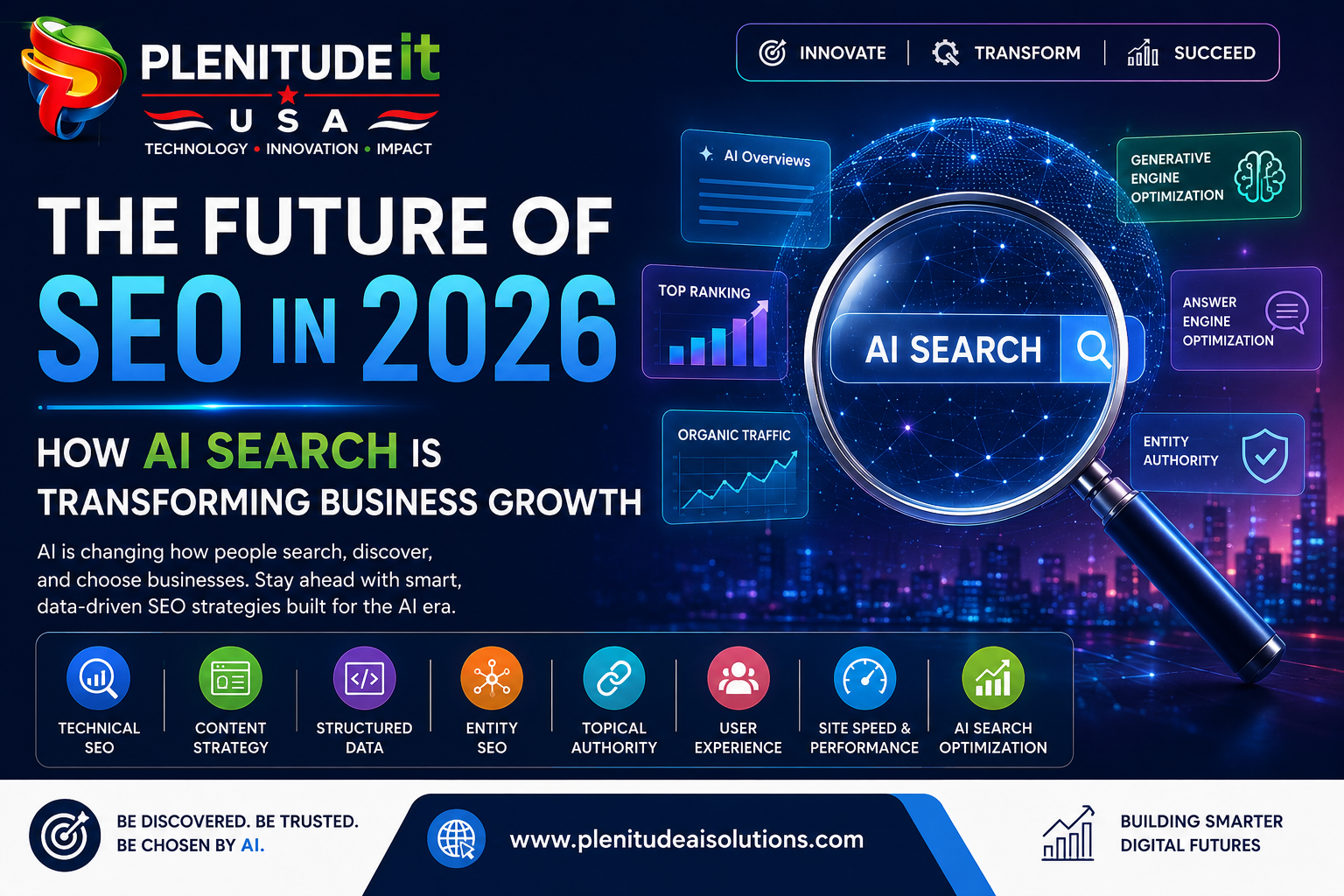
Search engine optimization has never been static. Over the past two decades, businesses have adapted to algorithm updates, mobile-first indexing, page experience signals, semantic search, and voice search. Today, another major transformation is reshaping how people discover information online—the rise of artificial intelligence.
Instead of simply presenting a list of links, modern search platforms increasingly generate intelligent answers, summarize content, compare solutions, and recommend trusted sources before users ever visit a website. Google’s AI Overviews, conversational AI assistants, and large language models (LLMs) are changing how businesses compete for online visibility.
For organizations that continue relying on outdated SEO tactics, this shift presents a significant challenge. However, for businesses willing to embrace AI-powered search optimization, it creates an opportunity to reach customers through entirely new discovery channels.
SEO in 2026 is no longer just about ranking web pages. It’s about building authority, demonstrating expertise, structuring information effectively, and creating content that both humans and AI systems trust.
Whether you’re a startup, a growing business, or a large enterprise, understanding how AI is transforming search can help you remain visible, competitive, and prepared for the future.
How Search Has Evolved
Search engines have changed dramatically over the years.
Early SEO focused almost entirely on keywords and backlinks. Businesses could achieve rankings simply by repeating keywords throughout their pages or acquiring large numbers of links.
As search technology matured, algorithms became significantly more sophisticated.
Google began evaluating:
- Content quality
- User intent
- Mobile usability
- Website performance
- Authority
- Trustworthiness
- Structured data
- User experience
Today, AI has introduced another major shift.
Instead of simply matching keywords, search systems now attempt to understand:
- Context
- Relationships
- Entities
- User intent
- Conversation history
- Business expertise
This allows search platforms to generate complete answers rather than simply displaying lists of webpages.
Why Traditional SEO Alone Is No Longer Enough
Many businesses still believe SEO consists of adding keywords to pages and building backlinks.
While these practices remain important, they represent only part of a much larger strategy.
Modern search optimization requires businesses to demonstrate genuine expertise while providing valuable, trustworthy, and comprehensive information.
Artificial intelligence evaluates much more than keywords.
AI systems analyze:
- Topic coverage
- Content quality
- Consistency
- Website authority
- Entity relationships
- Structured information
- Internal linking
- User engagement
- Business credibility
Organizations that publish thin content or focus only on rankings may find it increasingly difficult to compete as AI-powered search becomes more sophisticated.
What Is AI Search Optimization?
AI Search Optimization (AISO) is the process of preparing websites and digital content so they can be accurately understood, referenced, summarized, and recommended by artificial intelligence search systems.
Unlike traditional SEO, which primarily focuses on improving rankings within search engines, AI Search Optimization expands that objective by helping businesses become trusted sources of information for AI-powered platforms.
A successful AISO strategy combines multiple disciplines, including:
- Technical SEO
- Semantic SEO
- Entity Optimization
- Structured Data
- Content Strategy
- User Experience
- Internal Linking
- Knowledge Graph Optimization
- Website Performance
- Digital Authority
Rather than competing for a single ranking position, businesses optimize to become authoritative resources that AI systems confidently reference when generating responses.
Understanding Google AI Overviews
Google AI Overviews represent one of the biggest changes in modern search.
Instead of showing only traditional search results, Google increasingly generates AI-powered summaries that answer user questions directly at the top of the search results.
These summaries often combine information from multiple trusted websites before presenting a concise response.
For businesses, this means visibility depends not only on rankings but also on whether Google considers their content reliable enough to contribute to AI-generated answers.
Businesses that produce detailed, well-structured, authoritative content have significantly better opportunities to appear within these AI-generated experiences.
AI Search Is Bigger Than Google
Many organizations mistakenly assume AI search refers only to Google.
In reality, businesses now receive traffic and visibility from multiple AI-powered platforms, including:
- ChatGPT
- Gemini
- Microsoft Copilot
- Perplexity AI
- Claude
- You.com
- Brave Search
- AI-powered enterprise search platforms
Each platform uses different methods to retrieve, evaluate, and summarize information, making comprehensive optimization more important than ever.
Instead of optimizing for a single search engine, businesses should focus on creating trustworthy digital ecosystems that perform well across multiple AI-driven platforms.
The Rise of Conversational Search
Search behavior has changed dramatically.
Instead of searching:
“SEO company”
Users increasingly ask:
- Which SEO company is best for small businesses?
- How does AI affect search engine optimization?
- What is the difference between SEO and AI Search Optimization?
- Which digital marketing strategy works best in 2026?
These conversational questions require websites to provide detailed, context-rich answers rather than short keyword-focused content.
Businesses that organize information naturally and answer real customer questions are more likely to appear in conversational AI responses.
Why Businesses Must Adapt Now
Artificial intelligence is not replacing search engine optimization—it is expanding it.
Businesses that begin preparing today will develop stronger digital foundations while competitors continue relying on outdated SEO strategies.
Organizations that invest in AI-ready content, structured information, topical authority, technical excellence, and trustworthy branding will have significant advantages as AI-powered search continues to evolve.
The future belongs to businesses that optimize for both people and intelligent search systems.
Entity SEO: Building a Digital Identity That AI Can Understand
Search engines have evolved beyond simply matching keywords. Modern AI systems aim to understand who you are, what your business does, how you’re connected to other entities, and why your content should be trusted.
This concept is known as Entity SEO.
An entity can be a business, person, organization, product, location, or even a concept. Instead of viewing a website as isolated pages, AI connects these entities into a network of relationships.
For example, when someone searches for a trusted technology partner, AI doesn’t simply look for the phrase “technology company.” It evaluates signals such as:
- Company expertise
- Industry specialization
- Service offerings
- Business consistency
- Website authority
- Customer trust
- Content depth
- Structured data
- External references
The stronger your digital entity, the more likely AI systems are to recommend your business in search results and conversational responses.
Understanding SEO, GEO, AEO & AISO
Digital search optimization has expanded far beyond traditional SEO. Businesses that understand the differences between these approaches can create strategies that remain effective as search technology continues to evolve.
Search Engine Optimization (SEO)
SEO focuses on improving a website’s visibility within traditional search engines by optimizing content, technical performance, user experience, website architecture, backlinks, and search relevance.
Its primary objective is to increase qualified organic traffic.
Answer Engine Optimization (AEO)
AEO prepares content to answer specific user questions clearly and directly.
Instead of targeting only keywords, AEO focuses on creating concise, authoritative answers that search engines can feature in snippets, voice assistants, and AI-generated responses.
Well-written FAQs, structured content, and clear explanations significantly improve Answer Engine Optimization.
Generative Engine Optimization (GEO)
Generative Engine Optimization focuses on helping AI systems understand and reference your content when generating responses.
Rather than optimizing only for rankings, GEO emphasizes authority, topical depth, semantic relationships, and trustworthy information that AI can confidently summarize.
AI Search Optimization (AISO)
AI Search Optimization combines SEO, AEO, GEO, structured data, semantic optimization, and entity development into one comprehensive strategy.
Businesses adopting AISO optimize not only for Google but also for AI platforms such as ChatGPT, Gemini, Perplexity, Microsoft Copilot, Claude, and future intelligent search systems.
Organizations that implement AISO today are preparing for the next generation of online search.
Semantic SEO: Understanding Topics Instead of Keywords
Search engines no longer evaluate content based solely on repeated keywords.
Instead, they analyze the broader meaning behind a topic.
This is where Semantic SEO becomes essential.
Rather than writing an article focused exclusively on “AI SEO,” high-quality content naturally discusses related concepts such as:
- Artificial Intelligence
- Search Algorithms
- Structured Data
- Knowledge Graphs
- User Intent
- Content Strategy
- Technical SEO
- AI Search
- Website Architecture
- Digital Marketing
By covering related concepts comprehensively, businesses demonstrate expertise while helping AI systems understand the full context of the topic.
This results in stronger topical authority and greater visibility across search platforms.
Why Topical Authority Matters More Than Ever
Publishing dozens of unrelated articles rarely produces long-term SEO success.
Modern search engines reward websites that demonstrate expertise within clearly defined subject areas.
This is known as Topical Authority.
Instead of creating isolated content, businesses should develop interconnected content ecosystems where service pages, supporting blogs, FAQs, case studies, and resources reinforce one another.
For example:
Digital Marketing
↓
SEO Services
↓
Technical SEO
↓
AI Search Optimization
↓
Content Marketing
↓
Structured Data
↓
Entity SEO
↓
Google AI Overviews
↓
Generative Engine Optimization
↓
AI Content Strategy
This pillar-and-cluster structure signals expertise while strengthening internal linking and improving crawlability.
Structured Data Helps AI Understand Your Business
One of the biggest advantages businesses can gain today is implementing structured data.
Structured data provides additional context that helps search engines and AI systems understand your website more accurately.
Rather than relying solely on page content, AI can identify information such as:
- Business name
- Services
- Organization
- Reviews
- FAQs
- Contact details
- Locations
- Authors
- Products
- Articles
Structured data improves eligibility for rich search features while strengthening business credibility.
Businesses investing in AI-ready websites should treat structured data as a foundational element rather than an optional enhancement.
Why Every Business Should Prepare for AI Crawlers
Traditional search engines primarily crawl webpages.
Modern AI platforms increasingly retrieve information to understand topics, summarize content, answer questions, and recommend trusted resources.
Businesses should therefore ensure websites remain accessible, well-organized, and technically optimized.
Important considerations include:
- Logical website architecture
- Clear navigation
- Comprehensive service pages
- Internal linking
- Fast page speed
- Mobile optimization
- Crawlable content
- Consistent business information
- Helpful FAQs
- High-quality original content
Preparing websites for AI crawlers today improves long-term visibility as AI search continues expanding.
Building an AI-Friendly Website Architecture
Website architecture directly influences both user experience and search visibility.
A well-organized website allows visitors—and AI systems—to understand relationships between pages.
A modern business website should include:
- Homepage
- About Us
- Services
- Individual Service Pages
- Industry Solutions
- Technology Pages
- Case Studies
- Blog
- Resources
- FAQs
- Contact Page
Every service page should link naturally to supporting blogs, while every blog reinforces the relevant service pillar.
This interconnected structure helps search engines identify expertise while improving user navigation.
Content That AI Wants to Recommend
Artificial intelligence favors content that demonstrates expertise while genuinely helping users.
Rather than producing articles designed only to rank for keywords, businesses should focus on creating comprehensive resources that answer real questions.
High-quality AI-friendly content typically includes:
- Clear headings
- Logical structure
- Accurate information
- Real-world examples
- Helpful comparisons
- Frequently Asked Questions
- Internal references
- Original insights
- Actionable advice
- Consistent branding
Businesses that consistently publish valuable resources naturally become more trustworthy sources for AI-powered search.
Common SEO Mistakes Businesses Still Make
Despite rapid advancements in search technology, many organizations continue relying on outdated practices that limit online growth.
Some of the most common mistakes include:
- Publishing duplicate or low-value content.
- Focusing on keywords instead of user intent.
- Ignoring technical SEO fundamentals.
- Creating isolated pages without internal linking.
- Neglecting website performance and Core Web Vitals.
- Missing structured data opportunities.
- Overlooking mobile optimization.
- Failing to build topical authority.
- Treating AI as a replacement for quality content instead of a tool to enhance it.
- Publishing content without a long-term content strategy.
Businesses that avoid these pitfalls while investing in high-quality, authoritative content are far more likely to succeed in both traditional and AI-powered search.
The Future of Search Belongs to Businesses That Build Trust
Artificial intelligence is changing how people search, evaluate businesses, and make purchasing decisions. Ranking on the first page of Google is still valuable, but modern search success extends far beyond traditional blue links.
Today’s users interact with AI-powered assistants, conversational search engines, voice interfaces, and intelligent recommendation systems before making decisions. These platforms prioritize businesses that consistently demonstrate expertise, authority, trustworthiness, and relevance.
Rather than asking:
“How do I rank for this keyword?”
Businesses should begin asking:
- How can we become the most trusted source for this topic?
- How can AI understand our expertise?
- How can we provide genuine value to customers?
- How can our website become a complete knowledge resource?
Organizations that focus on answering these questions will build sustainable digital visibility that continues delivering value for years to come.
Preparing Your Business for the Next Generation of Search
The future of digital marketing is no longer about optimizing isolated webpages—it is about creating intelligent digital ecosystems.
Successful businesses are investing in:
- Comprehensive service pages
- Educational content
- Knowledge hubs
- Industry-specific resources
- AI-ready website architecture
- Structured data implementation
- Strong internal linking
- Digital authority
- Customer trust
- Continuous content improvement
Every blog, service page, case study, and FAQ contributes to a larger ecosystem that strengthens your online presence and increases the likelihood of being recommended by both search engines and AI-powered assistants.
Search is becoming increasingly conversational, personalized, and context-aware. Businesses that adapt now will be better positioned to capture future opportunities while competitors continue relying on outdated SEO techniques.
Why Choose Plenitude IT?
Finding the right digital transformation partner is about more than technical expertise. It requires a team that understands your business goals, industry challenges, customer expectations, and long-term growth strategy.
Since 2013, Plenitude IT has been helping businesses embrace technology with confidence. Our mission is to deliver practical, scalable, and future-ready digital solutions that help organizations improve efficiency, strengthen customer engagement, and accelerate sustainable growth.
We combine strategic thinking with modern technologies to build solutions that support businesses at every stage of their digital transformation journey.
Every solution is designed with one objective in mind—helping businesses achieve measurable, long-term success through innovation, technology, and strategic execution.
Frequently Asked Questions
1. What is AI SEO?
AI SEO is the process of optimizing websites and digital content to improve visibility across both traditional search engines and AI-powered search platforms such as Google AI Overviews, ChatGPT, Gemini, and Perplexity.
2. What is the difference between SEO and AI Search Optimization?
Traditional SEO focuses on improving search rankings, while AI Search Optimization (AISO) prepares websites to be understood, summarized, and recommended by AI-driven search experiences using structured content, entity optimization, and topical authority.
3. Will traditional SEO still matter in 2026?
Yes. Technical SEO, high-quality content, website performance, and user experience remain essential. However, these should now be combined with AI-focused strategies to maximize visibility.
4. What are Google AI Overviews?
Google AI Overviews are AI-generated summaries displayed within search results that provide direct answers by combining information from multiple trusted sources.
5. Why is Entity SEO important?
Entity SEO helps search engines and AI understand your business, services, products, and expertise, making it easier to connect your brand with relevant searches and recommendations.
6. What is Topical Authority?
Topical authority is established by publishing comprehensive, interconnected content around a specific subject area, demonstrating expertise and building trust with both users and search engines.
7. How can businesses prepare for AI-powered search?
Businesses should invest in high-quality content, structured data, semantic SEO, technical optimization, strong internal linking, fast website performance, and consistent business information.
8. Why choose Plenitude IT for SEO and AI Search Optimization?
Plenitude IT combines technical expertise, AI innovation, digital marketing, and business strategy to help organizations improve online visibility, generate qualified leads, and build sustainable long-term growth through modern search optimization.
Final Thoughts
The future of search is no longer defined by keywords alone. Artificial intelligence is reshaping how people discover businesses, evaluate services, and make purchasing decisions. Companies that invest in trustworthy content, intelligent website architecture, and AI-ready optimization today will be better prepared for the search experiences of tomorrow.
Success in 2026 and beyond requires a balanced strategy that combines traditional SEO fundamentals with AI Search Optimization, semantic understanding, entity development, and exceptional user experiences. Businesses that embrace this evolution will not only improve rankings but also strengthen brand credibility, increase customer trust, and create lasting competitive advantages.
Ready to Future-Proof Your Business with Plenitude IT?
The digital landscape continues to evolve, and businesses that innovate today will shape tomorrow’s success. Whether you’re looking to improve your search visibility, modernize your website, implement AI-powered solutions, develop custom software, launch a mobile application, or accelerate your digital marketing strategy, choosing the right technology partner is the first step toward sustainable growth.
At Plenitude IT, we combine more than a decade of industry experience with the latest advancements in artificial intelligence, software engineering, cloud technologies, website development, mobile applications, SEO, AI Search Optimization, and digital marketing. Our team works closely with businesses to understand their unique objectives, identify opportunities for innovation, and deliver scalable solutions that create measurable business impact.
We believe every business deserves technology that works smarter, adapts faster, and grows alongside its ambitions. That’s why we focus on building intelligent digital ecosystems—not just websites or marketing campaigns—that help organizations improve customer experiences, streamline operations, increase online visibility, and stay competitive in an AI-driven world.
Whether you’re a startup building your digital foundation, a growing business expanding into new markets, or an enterprise transforming legacy systems, Plenitude IT is committed to helping you achieve long-term success through strategic technology solutions tailored to your goals.
Partner with Plenitude IT and discover how AI-powered digital transformation can unlock new opportunities for innovation, efficiency, and sustainable business growth.