






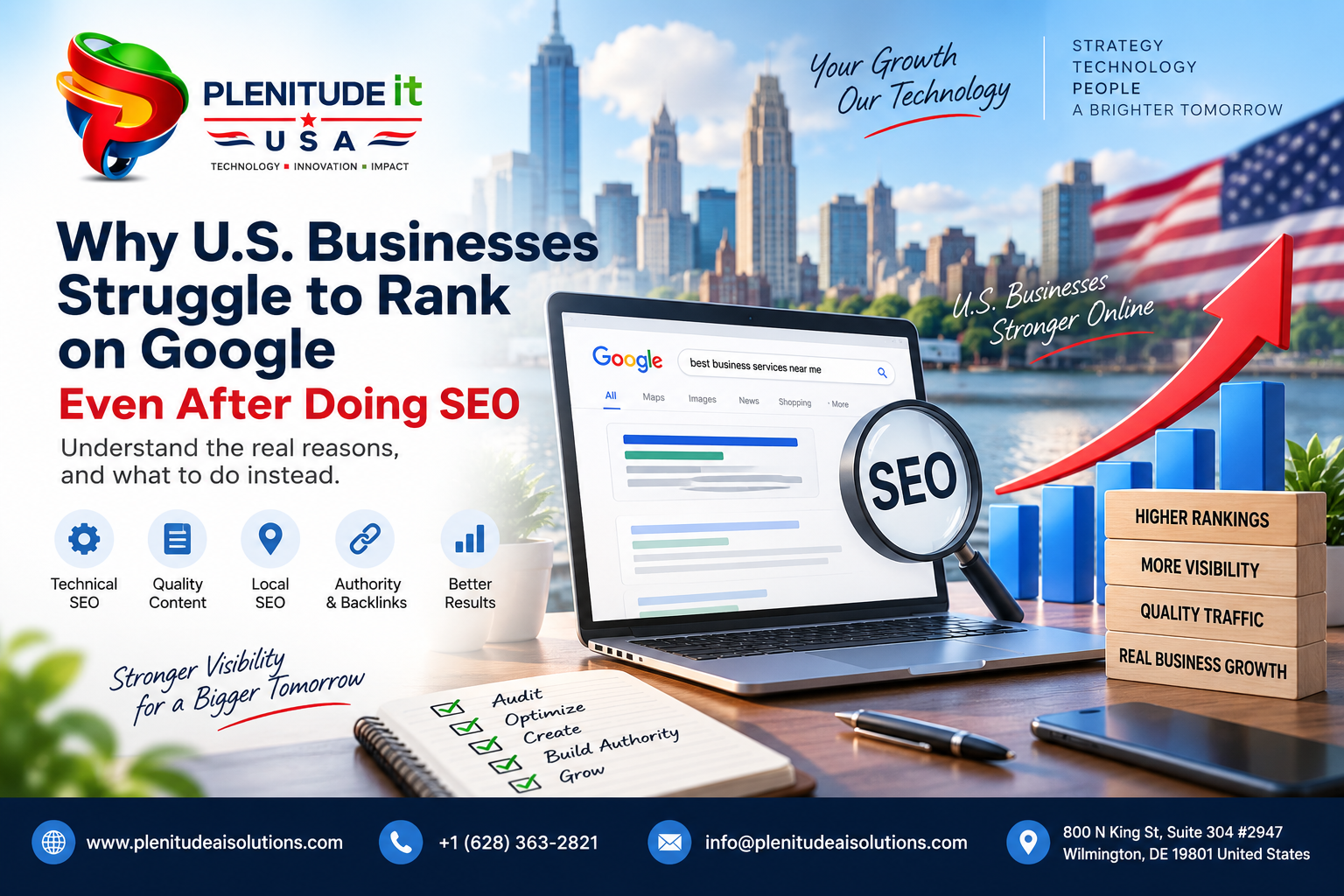
Ranking on Google sounds simple: optimize a website, publish content, build backlinks, and wait for traffic to grow.
In reality, many U.S. businesses invest in SEO and still find themselves buried beneath competitors.
Sometimes the problem isn’t that the business is doing too little SEO. It is that the SEO strategy is focused on the wrong things.
A website can have plenty of keywords and still fail to attract qualified visitors. It can have a professional design but weak technical foundations. It can publish articles every week but never answer the questions potential customers actually ask. A local business can even have a Google Business Profile and still struggle to appear when nearby customers are ready to buy.
For businesses competing in the United States, effective SEO requires a connected approach that considers technical performance, search intent, content, local visibility, website experience, authority and measurement.
Here are some of the most common reasons businesses struggle to rank — and what can be done about them.
1. The Website Was Built for the Business, Not the Searcher
One of the most common SEO problems starts before SEO even begins.
A business website may be designed around statements such as:
“We are a leading provider of innovative solutions.”
But that isn’t necessarily what a customer searches for.
A potential customer is more likely to search for:
- emergency plumber in Dallas
- commercial cybersecurity company
- accounting software for small businesses
- website development company in California
- managed IT services for healthcare
- digital marketing agency for restaurants
The difference is search intent.
Good SEO starts by understanding what people are actually trying to accomplish when they search.
Instead of building pages around what the company wants to say, businesses should build pages around the problems, services, questions and decisions that matter to their customers.
2. Targeting Keywords Without Understanding Search Intent
Keyword research is important, but collecting a large list of keywords isn’t an SEO strategy by itself.
Consider the keyword:
“cybersecurity.”
Someone searching that term could be:
- a student researching the subject
- an IT manager evaluating security solutions
- a business owner looking for a cybersecurity provider
- someone looking for cybersecurity news
- someone comparing software products
The keyword alone doesn’t tell you what page should rank.
A stronger SEO strategy separates searches into different intent types.
Informational
The searcher wants to learn.
Examples:
- What is technical SEO?
- How does local SEO work?
- Why is my website slow?
Commercial
The searcher is evaluating options.
Examples:
- Best SEO company for small businesses
- Enterprise SEO services
- Website development companies in the USA
Transactional
The searcher is ready to take action.
Examples:
- SEO services
- Hire an SEO company
- Local SEO services near me
Local
The searcher wants a nearby business or provider.
Examples:
- IT company near me
- SEO agency in Miami
- web design company in Delaware
Problem-based
The searcher describes a problem rather than a service.
Examples:
- Why is my website not ranking?
- Why did my Google traffic drop?
- Why isn’t my business showing on Google Maps?
A strong SEO campaign maps the right page to the right intent instead of trying to make one page rank for everything.
3. Technical SEO Problems Can Hold Back Good Content
A business may publish excellent content and still have difficulty gaining visibility if search engines encounter technical problems.
Technical SEO can involve:
- Crawlability
- Indexation
- XML sitemaps
- Robots.txt
- Canonical URLs
- Redirects
- Duplicate content
- Broken links
- Mobile usability
- Page speed
- Core Web Vitals
- URL structure
- Structured data
- JavaScript rendering
- Image optimization
- HTTPS and security
These aren’t necessarily visible to an ordinary website visitor.
That’s why a website can look completely fine while having SEO problems underneath the surface.
A technical SEO audit helps identify issues that could prevent important pages from being discovered, understood or properly indexed.
4. Publishing More Content Doesn’t Automatically Mean Better Rankings
Another common mistake is assuming that more blog posts equal better SEO.
A company publishes:
- 10 articles
- then 20
- then 50
- then 100
But organic traffic barely changes.
The problem may be content quality and relevance rather than content quantity.
Instead of asking:
“How many articles should we publish this month?”
A better question is:
“What useful information is missing from the search results that our customers need?”
For example, a commercial HVAC company could publish dozens of generic articles about HVAC systems.
A more useful strategy might answer practical questions such as:
- How much does commercial HVAC replacement cost?
- When should a business replace rather than repair an HVAC system?
- What should a facility manager check before hiring an HVAC contractor?
- How often should commercial HVAC systems be inspected?
- What happens when an HVAC system fails outside business hours?
This type of content can address actual purchasing concerns rather than simply filling a blog.
5. Important Services Don’t Have Their Own Search-Focused Pages
This is especially common with small and midsize U.S. businesses.
A company may offer ten different services but describe all of them on one page.
That makes it harder to create strong relevance around individual searches.
For example, an IT company might provide:
- Managed IT Services
- Cybersecurity
- Cloud Services
- IT Consulting
- Network Management
- Backup & Disaster Recovery
These services have different customers, search terms and buying journeys.
Dedicated service pages allow each offering to explain:
- What the service does
- Who needs it
- What problems it solves
- How the service works
- What customers should consider
- Why the provider is qualified
- What the next step should be
This creates a much clearer relationship between search query → relevant page → business solution.
6. Local SEO Is Often Underused
For businesses serving specific cities, states or regions, traditional organic rankings are only part of the opportunity.
Local search visibility can involve:
- Google Business Profile
- Business name and contact information consistency
- Local landing pages
- Reviews
- Relevant business directories
- Local citations
- Location-specific content
- Local links and mentions
- Service-area information
- Strong website-to-business-profile connections
A business shouldn’t create dozens of thin city pages simply to insert city names.
Instead, location content should provide genuine value.
For example, a company serving multiple areas could explain:
- which services it provides in that market
- the types of customers it serves
- local service considerations
- relevant projects or experience
- response areas
- useful local information
That produces a much stronger local presence than simply replacing one city name with another.
7. Backlinks Still Matter — But Random Links Aren’t the Answer
Backlinks remain part of the broader authority picture, but getting thousands of low-quality links is not a sensible strategy.
A better approach is to earn links and mentions from sources that make sense for the business.
Potential sources include:
- Industry publications
- Business directories
- Professional organizations
- Local organizations
- Partner businesses
- Relevant media
- Industry blogs
- Business profiles
- Digital PR campaigns
- Useful original research
The key question shouldn’t be:
“How many backlinks did we get?”
It should be:
“Did we gain relevant authority from websites that make sense for our business?”
A smaller number of genuinely relevant links can be far more useful than a large collection of unrelated links.
8. Internal Linking Is Often Forgotten
Businesses spend considerable time trying to earn external links while overlooking links they can control themselves.
Internal linking helps connect related content across a website.
For example:
SEO guide
↓
Technical SEO
↓
Local SEO
↓
SEO Services
Or:
Industry guide
↓
Relevant service
↓
Case study
↓
Contact page
Good internal linking helps visitors discover relevant information while also making the site’s content relationships clearer.
The goal isn’t to add links everywhere.
The goal is to create a logical information structure.
9. Website Experience Still Matters
SEO doesn’t end when someone clicks the search result.
If a visitor lands on a website that:
- loads slowly
- is difficult to navigate
- doesn’t work properly on mobile
- hides the phone number
- has confusing calls to action
- contains outdated information
- makes it difficult to understand the service
the ranking has little business value.
This is why SEO and website development shouldn’t be treated as completely separate activities.
The website needs to support the entire journey:
Search → Visit → Understand → Trust → Contact → Convert
10. Businesses Often Don’t Measure the Right Things
Another reason companies believe SEO isn’t working is that they measure only one metric:
ranking position.
Rankings matter, but they’re not the whole picture.
A stronger SEO measurement framework can include:
- Organic impressions
- Organic clicks
- Search queries
- Landing pages
- Qualified organic leads
- Phone calls
- Form submissions
- Conversion rates
- Local visibility
- New referring domains
- Branded search growth
- Revenue influenced by organic search
A keyword moving from position 18 to position 7 is useful.
But if another page produces qualified leads and revenue, that business outcome matters even more.
What U.S. Businesses Should Do Instead
Rather than treating SEO as a collection of isolated tasks, businesses should build a connected search strategy.
Start with the foundation
Audit:
- Technical SEO
- Indexation
- Site architecture
- Mobile experience
- Page performance
- Existing content
Then understand the market
Research:
- Customer searches
- Competitors
- Search intent
- Service opportunities
- Local opportunities
- Content gaps
Build the right pages
Create useful:
- Service pages
- Location pages where genuinely appropriate
- Industry pages
- Supporting articles
- FAQs
- Resource content
Strengthen authority
Develop:
- Relevant backlinks
- Business listings
- Digital PR
- Industry mentions
- Partnerships
- Reputation signals
Measure and improve
Review:
- Search performance
- Organic traffic
- Leads
- Conversions
- Content performance
- Technical health
Then improve the strategy based on what the data shows.
A Practical SEO Checklist for a U.S. Business
Before assuming SEO isn’t working, ask:
Website
- Is the website technically healthy?
- Can search engines discover the important pages?
- Is the website fast and mobile-friendly?
Content
- Does every important service have a useful page?
- Does the content address actual customer questions?
- Are pages built around search intent?
Local
- Is the business information consistent?
- Is the Google Business Profile properly optimized?
- Are there relevant local and industry citations?
Authority
- Does the business have relevant external mentions?
- Are backlinks coming from credible sources?
- Is the company building genuine industry authority?
Conversion
- Can visitors immediately understand what the company offers?
- Is contacting the business easy?
- Are important calls to action visible?
Measurement
- Are organic leads being tracked?
- Which pages generate business?
- Which search queries bring qualified visitors?
If several answers are “no,” the problem may not be that SEO doesn’t work.
The problem may be that the SEO foundation isn’t complete yet.
SEO in 2026 Is About Being the Best Answer, Not Just Having the Most Keywords
Search is becoming more complex, but the fundamental objective remains surprisingly simple:
Help the right person find the right information at the right time.
For U.S. businesses, that means building websites that clearly communicate what the company does, creating genuinely useful content, developing local and industry authority, maintaining strong technical foundations and continuously improving based on real search and business data.
AI-powered search is also becoming another way people discover businesses and information. That makes clear business entities, trustworthy content and strong digital authority increasingly relevant — but businesses shouldn’t abandon traditional SEO fundamentals in pursuit of every new search trend.
The strongest strategy is to build a solid SEO foundation first and then expand as search behavior evolves.
How Plenitude IT Can Help
Plenitude IT provides SEO services for businesses across the USA, combining technical SEO, on-page optimization, content strategy, local SEO, authority building, internal linking and performance measurement.
The goal isn’t simply to chase rankings.
It’s to build a search presence that can attract relevant visitors, support qualified leads and contribute to long-term business growth.
Explore SEO Services in the USA →
Frequently Asked Questions
Common reasons include technical SEO problems, weak search intent targeting, insufficiently useful content, poor site architecture, limited authority, local SEO gaps or strong competition. An SEO audit can help identify the specific issues.
There is no universal timeframe. Results depend on competition, website condition, industry, authority, content quality and the amount of work being implemented. SEO is generally a long-term process rather than an overnight marketing tactic.
Yes, backlinks can contribute to a site’s authority, but relevance and quality are more important than simply accumulating large numbers of links.
Yes. Businesses that depend on customers in particular geographic areas can benefit from local SEO, location relevance, business profile optimization, reviews, citations and locally useful content.
They serve different purposes. Paid advertising can provide immediate visibility while SEO can build organic visibility over time. Many businesses benefit from using both strategically rather than treating them as mutually exclusive.