





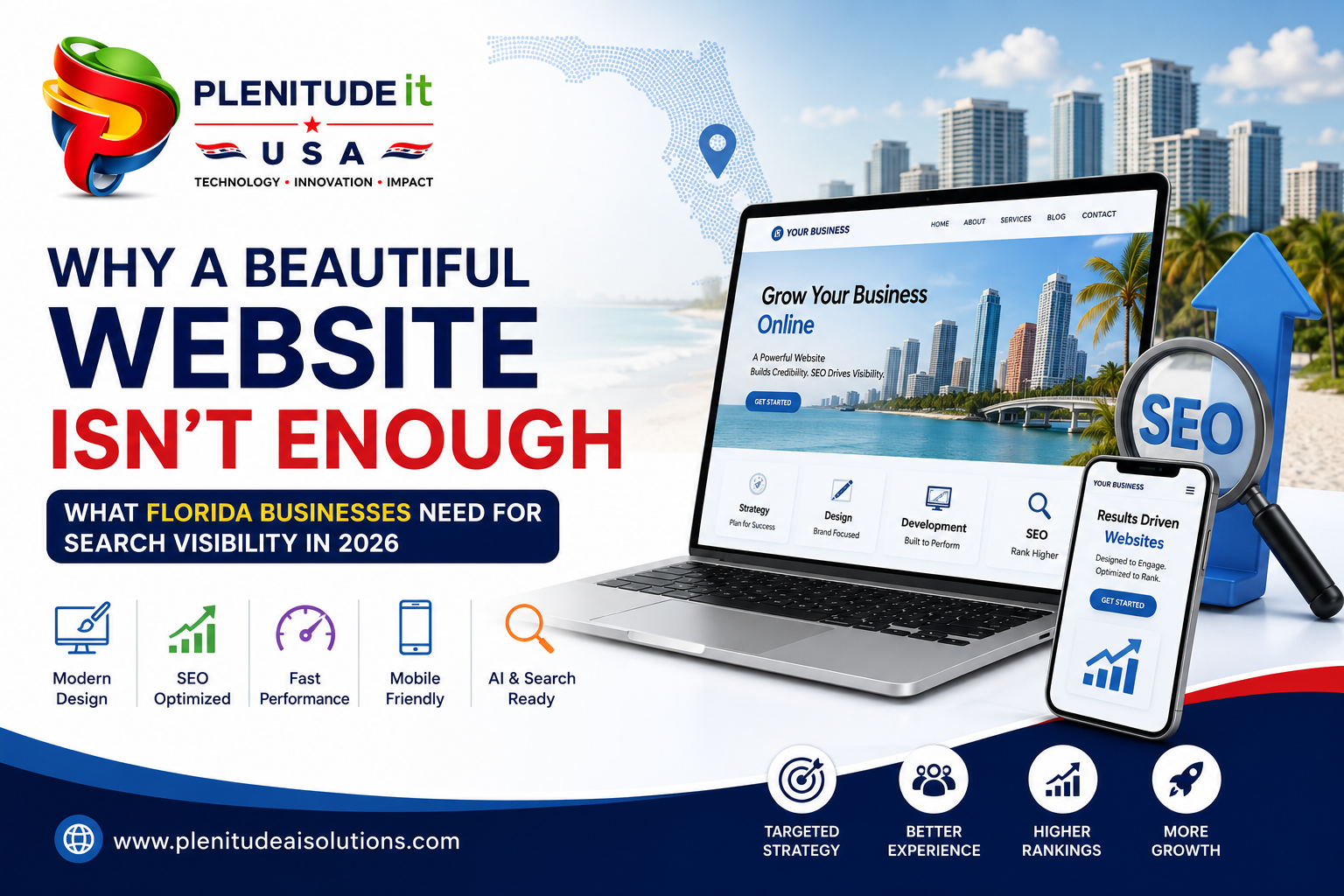
A business can have a modern logo, professional photography, attractive animations, and a beautifully designed website—and still struggle to attract visitors from search.
That can be frustrating.
You invest in a new website expecting it to become an important source of customers. The site looks excellent on a laptop and works well on a phone, but months later, organic traffic remains limited.
The problem is often not the visual design.
The problem is that website design and search visibility were treated as two separate projects.
For businesses in Florida, where customers can compare dozens of providers before making a decision, that distinction matters.
A successful business website in 2026 needs to do more than look professional. It needs to be understandable to search engines, useful to visitors, technically sound, easy to navigate, and increasingly prepared for AI-powered search experiences.
A Website Can Look Great and Still Be Difficult to Find
Think about two websites.
The first has:
- impressive graphics
- large images
- modern animations
- attractive colors
- professional branding
The second may look less dramatic, but it has:
- clear service pages
- logical navigation
- useful content
- descriptive page titles
- strong internal links
- fast-loading pages
- mobile-friendly layouts
- clear business information
- well-organized content
Which one will perform better in search?
There is no guarantee that the second will automatically outrank the first, but it has a much stronger foundation for being understood, crawled, indexed, and matched with relevant searches.
Good website design should support discoverability—not compete with it.
The Real Connection Between Website Design and SEO
SEO is often treated as something that happens after a website has been designed.
A business launches its new website and then asks:
“Can we add SEO now?”
That approach can create unnecessary problems.
Some SEO decisions are closely connected to the website’s structure from the beginning.
For example:
Navigation
Can visitors and search engines easily understand how your services, products, locations, and important information are organized?
Page hierarchy
Does each important topic have an appropriate page?
Headings
Does the page clearly communicate what it is about?
URLs
Are the URLs descriptive and meaningful?
Internal linking
Can visitors move naturally between related services, resources, and supporting content?
Mobile experience
Does the website remain usable when customers visit from a phone?
Performance
Does the page load efficiently without unnecessary technical weight?
Content structure
Can someone quickly understand what the business does, who it serves, and why it is relevant?
These are not simply “SEO tasks.”
They are part of building a better website.
Florida Businesses Have a Visibility Challenge
Florida is not one uniform market.
A business serving customers in Miami may face a very different search environment from a business operating in Tampa, Orlando, Jacksonville, Fort Lauderdale, Naples, or smaller communities.
Customers may search for:
- a service near them
- a company in their city
- a specific type of provider
- a solution to a particular problem
- reviews and comparisons
- pricing information
- local availability
- answers to questions before contacting a business
That means a website shouldn’t simply say:
“We provide high-quality services.”
It needs to communicate what the business provides, who it serves, where it operates, and why the information is useful.
This is where website content and SEO begin working together.
Don’t Build a Website Around Design Alone
One of the easiest mistakes to make is starting a website project with:
“What should the homepage look like?”
A better question is:
“What does our customer need to find, understand, and do?”
That changes the design process.
Before the visual design is finalized, a business should consider:
What are our most important services?
What questions do customers ask?
Which pages should appear in search?
What information should be immediately accessible?
Which pages should support other pages?
What actions do we want visitors to take?
The answers can influence the website’s architecture before a designer creates the first layout.
Your Homepage Shouldn’t Have to Do Everything
Another common website problem is trying to put the entire business onto one homepage.
A homepage might mention:
- every service
- every industry
- every location
- every product
- every benefit
- every customer type
The result can be a page that says a little about everything but doesn’t provide enough depth about anything.
A better approach is to give important subjects their own appropriate pages.
For example:
Homepage
Provides the overall business story and directs visitors to important areas.
Service pages
Explain individual services in meaningful detail.
Location pages
Explain relevant local offerings where location-specific intent genuinely exists.
Industry pages
Explain how solutions apply to specific customer groups where appropriate.
Resource content
Answers questions and provides useful information that supports the wider topic.
This creates a clearer information architecture for both users and search engines.
SEO-Friendly Website Design Starts With Search Intent
A customer searching:
“web design company Florida”
has a different intent from someone searching:
“how much does a business website cost?”
And someone searching:
“why is my website not generating leads?”
has a different problem again.
A strong website strategy doesn’t simply collect keywords.
It asks:
What is this person actually trying to accomplish?
That intent should influence the page, its content, its structure, and its call to action.
For example:
| Search intent | Useful page/content |
|---|---|
| Looking for a service | Service page |
| Comparing solutions | Comparison or guide |
| Researching a problem | Educational article |
| Looking for a local provider | Relevant location/service page |
| Ready to contact a company | Conversion-focused service page |
| Looking for an answer | Focused informational content |
This is one reason SEO-friendly website design should begin before development is complete.
Technical SEO Is Part of the Website
You don’t necessarily need to be a technical SEO expert to understand the principle.
A website needs a technical foundation that allows search engines to access and understand its important content.
That can involve:
- Crawlable pages
- Logical URL structures
- Appropriate redirects
- Mobile usability
- Page performance
- Canonicalization
- Indexation controls
- XML sitemaps
- Structured data where appropriate
- Secure connections
- Clean internal linking
- Accessible content
These details are rarely visible to a customer looking at a homepage.
But they can influence how effectively the website functions as a search asset.
Website Speed Is More Than an SEO Checkbox
People don’t visit websites because they want to admire how much code was used to build them.
They visit because they want something.
They want to:
- find a service
- read information
- compare options
- make a purchase
- request a quote
- call a business
- book an appointment
- solve a problem
If the website makes that process unnecessarily slow or difficult, visual design loses some of its value.
That is why performance should be considered during development rather than treated as a repair job after launch.
A visually impressive website that makes customers wait is not necessarily a successful website.
Mobile Experience Is Part of the First Impression
For many businesses, a large portion of website visits can come from mobile devices.
That means the mobile version should not simply be a smaller version of the desktop website.
The design should consider:
- readable typography
- touch-friendly buttons
- simple navigation
- appropriately sized images
- clear calls to action
- fast loading
- easy-to-scan content
A visitor shouldn’t have to pinch, zoom, scroll sideways, or search through a complicated menu to understand what the business offers.
What About AI Search?
This is where website strategy is changing.
People increasingly use conversational search and AI-powered experiences to research businesses, products, services, and questions.
Google itself added new guidance in 2026 covering optimization for generative AI features in Search, while emphasizing that existing SEO fundamentals remain important.
That doesn’t mean businesses should abandon Google SEO and start chasing every new AI acronym.
In fact, the fundamentals overlap considerably.
AI-powered search still benefits from information that is:
- clear
- useful
- specific
- trustworthy
- well organized
- relevant to the question
- easy to understand
This makes good website architecture and high-quality content even more important.
Don’t Build Content Just for AI
There is already plenty of advice online telling businesses to create content specifically to “get cited by AI.”
That can lead to another form of SEO obsession.
Instead, ask a simpler question:
Would this page genuinely help a customer understand the subject?
If the answer is yes, you are already moving in the right direction.
Google’s current guidance also warns against treating generative AI optimization as a replacement for fundamental SEO practices.
A useful page can serve several purposes at once:
Customer → understands the service
Google → understands the topic
AI search → can interpret the information
Business → gets a better-qualified visitor
That’s a much healthier objective than writing content solely because an algorithm might extract it.
Local SEO Should Be Built Into the Website Carefully
For a Florida business serving a particular market, local relevance can be important.
But that doesn’t mean creating dozens of nearly identical city pages and changing only the city name.
That approach can create thin content and a poor user experience.
Instead, location-focused content should exist when there is a genuine reason to provide information for that location.
A useful local page might explain:
- services available there
- customers served
- relevant local considerations
- areas covered
- genuine business experience
- useful location-specific information
Local SEO works best when location relevance adds value rather than simply adding a place name.
Your Website Should Answer the Questions Customers Actually Ask
One of the simplest ways to improve a website is to listen to customers.
What do they ask before contacting you?
What makes them hesitate?
What do they misunderstand?
What do they compare?
What information do they repeatedly request?
Those questions can become useful website content.
For example:
“How much does a website cost?”
could become a useful pricing guide.
“How long does website development take?”
could become a process explanation.
“Do you work with businesses in my area?”
could become useful service-area information.
“Can my existing website be redesigned?”
could become a redesign guide.
This creates content with an actual purpose rather than publishing articles simply to increase the number of pages on the website.
SEO Should Influence Website Content Before Launch
A common workflow looks like this:
Design → Development → Launch → SEO
A stronger workflow is:
Business strategy → Search intent → Site architecture → Content → Design → Development → Technical SEO → Launch → Ongoing optimization
The difference is important.
SEO isn’t being “added” to the website.
It is being considered as part of the website’s foundation.
What Should a Florida Business Review on Its Website?
If you’re considering a new website or redesign, start with these questions.
1. Can someone understand what we do within seconds?
If not, the messaging may need work.
2. Are our most important services clearly represented?
Important services shouldn’t be buried inside generic homepage content.
3. Does every important service have enough useful information?
A thin page may not adequately serve either users or search intent.
4. Can customers easily navigate the website?
Good navigation reduces friction.
5. Does the site work well on mobile?
The mobile experience deserves independent attention.
6. Are important pages technically accessible?
Search visibility requires a crawlable and indexable foundation.
7. Are related pages connected?
Internal linking helps visitors discover relevant information and gives search engines additional context.
8. Does our content demonstrate actual expertise?
Generic content is easy to produce. Useful, original information is more valuable.
9. Does the website reflect where we actually do business?
Location information should be accurate and meaningful.
10. Are we prepared for changing search behavior?
A website should be built on durable principles rather than temporary SEO tricks.
The Website Launch Is Not the Finish Line
Launching a new website can feel like the end of a project.
From a search perspective, it is often the beginning.
After launch, businesses can monitor:
- Search impressions
- Organic clicks
- Search queries
- Ranking trends
- Page performance
- User behavior
- Conversion paths
- Technical issues
- Content opportunities
Search data can reveal questions and opportunities that weren’t obvious during the initial website project.
That information can then guide future content, landing pages, improvements, and SEO work.
So, What Does a Search-Ready Website Look Like?
It doesn’t necessarily mean a website filled with keywords.
It doesn’t mean adding hundreds of pages.
It doesn’t mean stuffing every heading with a city name.
And it doesn’t mean redesigning everything around AI.
A search-ready website is simply a website that makes its information easy to understand, easy to navigate, useful to people, technically accessible, and connected to genuine business intent.
For a Florida business, that means the website should work as more than a digital brochure.
It should become part of the company’s customer acquisition system.
How Plenitude IT Can Help
Building a website that looks professional is only one part of a successful digital presence.
Plenitude IT approaches website design and development with the wider digital environment in mind—from structure and user experience to content organization, technical foundations, search visibility, and ongoing growth.
Our broader capabilities can help businesses connect:
Website Design → Development → SEO → Digital Marketing → Search Visibility
The objective isn’t to build a website simply because the old one looks outdated.
It is to build a website that gives your business a stronger foundation for being discovered, understood, trusted, and contacted.
For Florida businesses planning a new website or considering a redesign, the most useful question may not be:
“How should our new website look?”
It may be:
“What should our website accomplish for the business?”
Once that question is answered, design, development, SEO, content, and conversion strategy can start working toward the same goal.
Your website should not simply represent your business online. It should help your business get found and chosen.
Explore Website Design & Development
If your current website looks good but isn’t generating the visibility or enquiries you expect, it may be time to look beyond the design itself.
Plenitude IT can help you evaluate the structure, experience, development, and search foundations of your next website.