





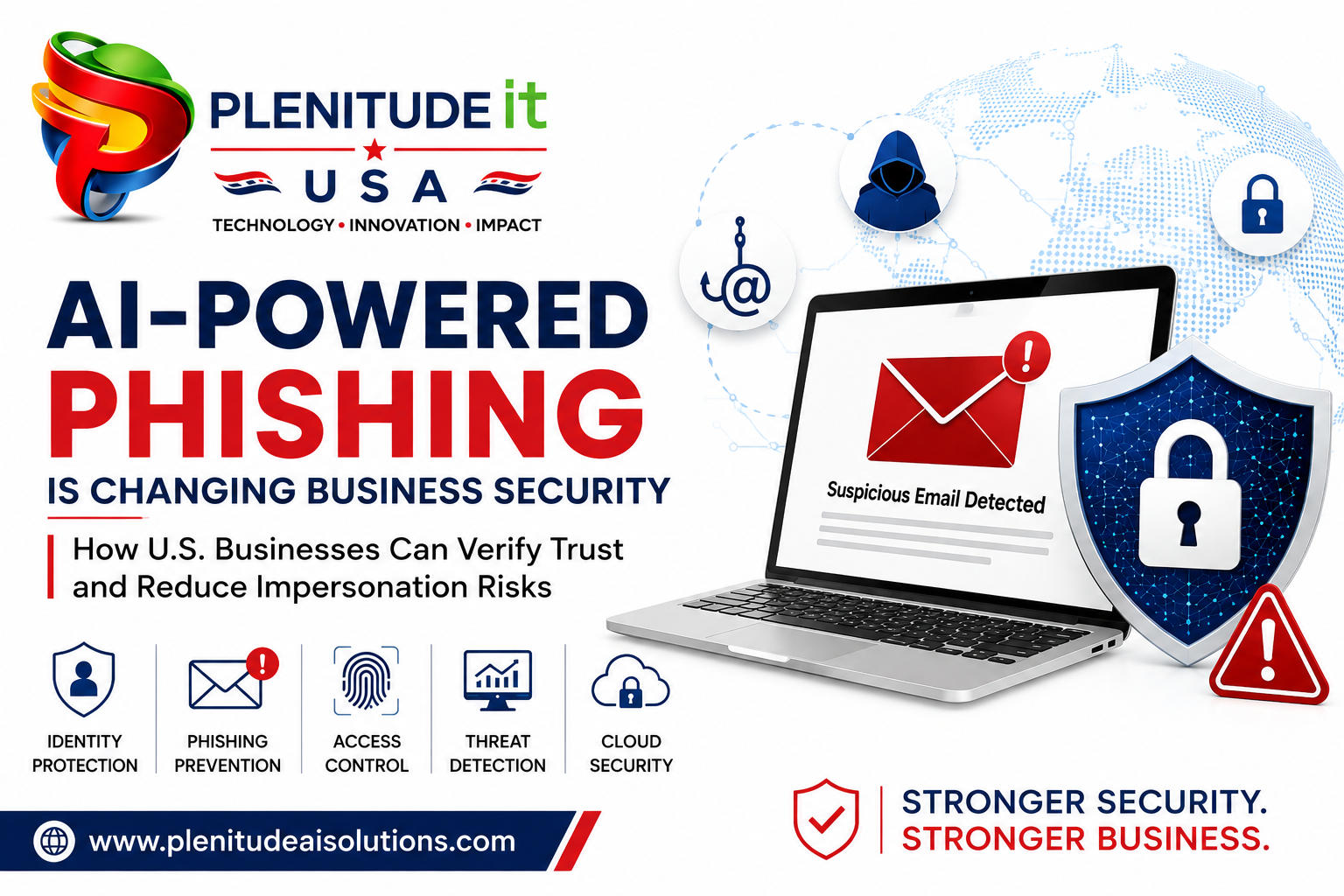
AI-powered phishing is making traditional security warning signs less reliable. Here’s how U.S. businesses can reduce the risk of fake emails, cloned voices, and fraudulent requests.
For years, businesses have trained employees to look for obvious phishing warning signs.
Poor grammar.
Strange email addresses.
Suspicious links.
Unusual wording.
An urgent request for money.
Those checks still matter. But there is a new problem: the quality of fraudulent communication is improving rapidly.
Artificial intelligence can help attackers create convincing emails, messages, social-engineering campaigns, and other forms of impersonation at greater speed and scale. Recent cybersecurity research shows that AI-generated phishing is already affecting organizations, rather than being simply a future threat.
For U.S. businesses, this creates an important question:
What happens when an employee can no longer confidently determine whether a request is genuine just by looking at the message?
The answer is not to expect employees to become perfect human lie detectors.
The better approach is to build verification into the business process itself.
The Problem: Trust Is Becoming Easier to Fake
Imagine a finance employee receives an email that appears to come from the company’s CEO.
The message is short:
“I’m in a meeting. Please process this payment today and send me confirmation.”
The email looks professional.
The writing sounds like the CEO.
The request isn’t completely unusual.
A few minutes later, the employee receives a message through another communication channel reinforcing the request.
Nothing about the situation immediately looks like the traditional phishing examples employees were taught to identify.
Now consider a more advanced scenario.
The attacker uses information already available about the company to make the communication more believable. A voice message may sound like a familiar executive. A message may reference a real customer, project, supplier, or internal process.
This is where cybersecurity moves beyond the question:
“Does this email look suspicious?”
The more important question becomes:
“How does our business verify that this person is actually authorized to make this request?”
That is a much stronger security question.
Why AI Makes Social Engineering More Difficult
AI does not necessarily need to invent an entirely new type of cyberattack.
Instead, it can make existing techniques more convincing and scalable.
Phishing, business email compromise, social engineering, fraud, and credential theft have existed for years. What is changing is the ability to generate more realistic communication and adapt it to different targets.
Verizon’s 2026 Data Breach Investigations Report notes that generative AI is now being used to bolster multiple attack techniques. The report also identifies system vulnerabilities, credential abuse, and phishing among important routes into organizations.
This creates several challenges for businesses.
1. Messages can become more convincing
Employees have traditionally been taught to look for obvious mistakes.
AI can reduce those obvious mistakes.
2. Personalization can increase
Publicly available information about executives, employees, suppliers, customers, and company operations can provide attackers with useful context.
3. Attacks can scale
One attacker can potentially create and adapt large volumes of targeted communication much faster than before.
4. Voice and visual trust can also be manipulated
The problem is no longer limited to email.
Businesses increasingly need to consider whether a voice message, video call, chat message, or other digital interaction should automatically be trusted.
Experian’s 2026 U.S. report specifically identifies deepfake scams and AI-generated phishing as part of the changing fraud environment.
The Biggest Mistake: Relying Only on Employee Awareness
Employee training remains important.
But training alone should not be the entire security strategy.
Consider a simple financial approval process.
If the only security control is:
“Employees should recognize suspicious requests.”
the business is placing a large amount of responsibility on one person making a decision under pressure.
A stronger approach could require:
- Identity verification
- Multi-factor authentication
- Role-based permissions
- Separate approval for high-value transactions
- Verification through a trusted communication channel
- Logging of important actions
- Monitoring for unusual activity
Now the employee doesn’t have to determine everything alone.
The process itself provides additional protection.
This is the fundamental shift businesses should consider.
A Better Solution: Move From Trust to Verification
The solution isn’t to stop trusting employees, customers, suppliers, or executives.
It is to stop treating a digital message as sufficient proof of identity or authorization.
A practical security model asks several questions.
Who is requesting this?
Is the person’s identity authenticated?
Are they authorized?
Does this employee actually have permission to make this request?
Is the request normal?
Does it match the person’s usual activity?
Is the timing unusual?
Is there something about the request that deserves additional verification?
Does the transaction require another approval?
Should a second person confirm it?
Can the request be independently verified?
Can the employee contact the person through an established channel rather than replying directly to the suspicious message?
These controls can make social-engineering attacks significantly harder to complete.
What U.S. Businesses Can Do Now
A business does not necessarily need to replace its entire IT environment to start improving its security posture.
Instead, it can begin with several practical areas.
1. Strengthen Identity Security
Identity should be treated as a major security control.
Businesses should review:
- Multi-factor authentication
- Privileged accounts
- Administrator access
- Password policies
- Employee access
- Former employee accounts
- Service accounts
- Cloud identities
The objective is simple:
A stolen password should not automatically equal unrestricted access.
Identity is becoming even more important as employees, applications, cloud platforms, automation systems, and AI tools increasingly interact with business information.
Recent SANS research found that identity-related attacks remain a significant concern, with many organizations also deploying AI agents and automation that require credentials.
2. Create Verification Rules for High-Risk Requests
Not every email needs a complicated security procedure.
But certain requests should trigger additional verification.
For example:
- Bank account changes
- Wire transfers
- Payroll changes
- Password resets
- Administrator access
- Sensitive data requests
- Vendor payment changes
- New beneficiary details
- Emergency financial requests
A simple rule can be extremely valuable:
Never approve a high-risk request solely because it came from a familiar person or email account.
Instead, establish a second verification method.
For example, an employee could independently contact the executive or supplier using a known phone number or established business channel.
3. Protect Email Accounts
Email accounts are often central to business operations.
If an attacker gains access to an employee’s mailbox, they may be able to observe conversations, understand business relationships, and impersonate the account owner.
Businesses should therefore review:
- MFA
- Account recovery settings
- Suspicious login monitoring
- Email forwarding rules
- Administrator permissions
- Security alerts
- Authentication configuration
- User access
The objective is not simply to block spam.
It is to protect the identity and business information contained inside the communication environment.
4. Don’t Ignore Software Vulnerabilities
AI-powered social engineering receives a lot of attention, but businesses should not allow the trend to distract them from conventional security weaknesses.
Verizon’s 2026 DBIR reports that 31% of breaches now start with software vulnerabilities, making exploitation a leading initial access route.
That means businesses still need to maintain the fundamentals:
- Patch operating systems
- Update applications
- Secure websites
- Review exposed services
- Protect APIs
- Monitor infrastructure
- Remove unsupported software
- Review cloud configurations
A business can have excellent phishing awareness and still be exposed through an unpatched system.
5. Protect Endpoints and Devices
Employees may access business systems from:
- Laptops
- Desktops
- Smartphones
- Tablets
- Remote work environments
Every connected device becomes part of the security environment.
Endpoint protection should therefore be considered alongside identity and network security.
Businesses should understand:
Which devices have access?
Who controls them?
Are they updated?
What happens if one is compromised?
Can suspicious activity be detected?
These questions become particularly important for organizations with distributed or remote workforces.
6. Prepare for the Moment Something Goes Wrong
Even strong security controls cannot guarantee that an organization will never experience an incident.
The more practical objective is resilience.
A business should know:
- Who responds to an incident?
- Who has authority to isolate systems?
- Where are backups stored?
- How quickly can important systems be restored?
- Who communicates with customers?
- Who handles legal or regulatory requirements?
- How are affected accounts secured?
- How is evidence preserved?
A cybersecurity strategy without an incident-response plan can leave an organization improvising during its most difficult moment.
7. Use AI to Defend Against AI
There is an important positive side to the current AI security discussion.
AI isn’t only helping attackers.
Organizations are also using AI for security activities such as threat detection, anomaly detection, threat intelligence analysis, and phishing and fraud detection. CDW’s 2026 research found that organizations are already using AI across several defensive security functions.
This creates an opportunity.
Instead of asking:
“How do we stop AI?”
businesses should increasingly ask:
“How can we use appropriate technology to identify and respond to threats faster?”
That could involve automated detection, behavioral analysis, security monitoring, anomaly identification, and other defensive technologies.
But AI should support a broader security architecture rather than become the entire strategy.
A Practical Security Model for a U.S. Business
For many organizations, the most useful approach is to think about cybersecurity as several connected layers.
Identity
Who is accessing the system?
Access
What are they allowed to do?
Devices
Is the device trustworthy and appropriately protected?
Applications
Are the software and web applications secure?
Network
How is traffic protected and monitored?
Data
What information is being accessed or transferred?
Monitoring
Can unusual activity be detected?
Response
What happens when something goes wrong?
Recovery
How quickly can the business restore critical operations?
This layered approach is more practical than searching for one product that promises to “solve cybersecurity.”
The New Security Question for Business Leaders
For a long time, cybersecurity conversations focused heavily on prevention.
Block the malware.
Stop the phishing email.
Secure the firewall.
Protect the password.
Those controls remain important.
But AI-driven impersonation highlights another issue:
Can your business verify trust when digital communication looks completely legitimate?
That question affects finance teams, executives, HR departments, IT teams, customer service departments, and anyone who handles sensitive information or financial decisions.
The answer cannot depend entirely on whether an employee notices something suspicious.
It needs to be supported by identity controls, access management, verification procedures, monitoring, secure infrastructure, employee awareness, and incident-response planning.
Cybersecurity Is Becoming a Business Process
The most important change may not actually be technological.
It is organizational.
Cybersecurity increasingly needs to become part of everyday business processes.
When a supplier changes bank details, there should be a verification process.
When an executive requests an unusual payment, there should be an approval process.
When an employee leaves, access should be removed.
When a critical system is compromised, there should be a response plan.
When sensitive information is accessed, appropriate controls should exist.
That is how cybersecurity becomes part of business resilience rather than simply an IT expense.
What Should a Business Do First?
If your organization has never reviewed its security posture comprehensively, don’t start by buying every cybersecurity product available.
Start with the basics.
Step 1 — Identify critical systems
What systems would seriously affect the business if they became unavailable?
Step 2 — Identify sensitive information
Where is customer, financial, employee, or operational information stored?
Step 3 — Review identities
Who has access, and do they still need it?
Step 4 — Review high-risk processes
Which activities could cause significant financial or operational damage if manipulated?
Step 5 — Review technical exposure
Check applications, endpoints, networks, cloud systems, and software vulnerabilities.
Step 6 — Establish monitoring
Determine whether suspicious activity can actually be detected.
Step 7 — Prepare for incidents
Make sure the organization knows what to do if prevention fails.
This creates a more useful starting point than simply asking:
“Do we have antivirus?”
Final Thought: Don’t Try to Outsmart AI With Humans Alone
AI-powered phishing and impersonation are changing the security environment because they attack something businesses have always depended on:
trust.
When a fraudulent message can look professional, sound familiar, and contain realistic business context, asking employees to identify every attack becomes increasingly difficult.
The stronger solution is to design business systems so that trust is verified rather than assumed.
For U.S. companies, that means combining employee awareness with identity security, access controls, secure infrastructure, vulnerability management, monitoring, incident response, and recovery planning.
AI may make attacks more convincing.
But businesses can also use better security architecture to make those attacks harder to complete.
The goal isn’t to make employees suspicious of everything.
The goal is to build a business where a convincing fake still cannot easily become a successful attack.
How Plenitude IT Can Help
Cybersecurity is not just about installing security software. U.S. businesses need a practical security strategy that considers people, identities, devices, applications, networks, cloud environments, data, and business operations together.
Plenitude IT helps businesses evaluate and strengthen these areas through a broader range of cybersecurity and IT capabilities.
Our cybersecurity services can support businesses with:
- Network Security — protecting network environments and controlling unauthorized access.
- Endpoint Security — securing employee devices and business endpoints.
- Cloud Security — protecting cloud-based systems, workloads, and business data.
- Data Security — helping safeguard sensitive business and customer information.
- Identity & Access Security — strengthening authentication, permissions, and user access.
- Vulnerability & Risk Assessment — identifying weaknesses that could expose business systems.
- Security Monitoring & Threat Detection — helping identify suspicious activity and potential threats.
- Incident Response — preparing businesses to respond effectively when security incidents occur.
The goal is not to add unnecessary complexity. It is to identify the security gaps that matter most to your business and build practical controls around them.
If your organization is reviewing its cybersecurity posture, dealing with increasing phishing and impersonation risks, or planning stronger protection for its IT environment, Plenitude IT can help you evaluate the right approach for your business.
Protect your business before a convincing attack becomes a costly incident.