





A plumbing company does not need more website visitors simply for the sake of having more traffic.
It needs the right homeowner or business owner to find the company at the right moment, understand what the company can do, trust it enough to make contact, and have an easy way to book the job.
That might happen when someone searches for an emergency plumber near me after a pipe bursts. It might be a homeowner researching water heater repair, a property manager looking for a commercial plumber, or someone comparing local companies before scheduling a major sewer repair.
And increasingly, that search may not begin with a traditional Google results page. People are also asking AI-powered search tools questions such as which plumber serves their area, which company handles a particular problem, or what they should look for before hiring a plumbing contractor.
That changes what a plumbing company’s digital presence needs to accomplish.
A modern plumbing business needs more than a nice-looking website. It needs a connected strategy involving website design, local SEO, content, digital marketing, reputation, mobile technology, and AI search visibility.
Here is what that looks like in 2026.
Why Plumbing Companies Need a Different Digital Strategy
Marketing a plumbing company is not quite the same as marketing a professional service where customers might spend weeks researching before making a decision.
Plumbing searches are often triggered by a problem.
A homeowner may search:
- Emergency plumber near me
- 24 hour plumber
- Water heater repair
- Drain cleaning service
- Sewer line repair
- Burst pipe repair
- Plumber open now
- No hot water
- Leaking water heater
- Commercial plumber near me
The urgency behind these searches matters.
Current U.S. plumbing keyword research continues to show strong demand around terms such as “plumber near me,” “water heater repair,” “emergency plumber,” “emergency plumber near me,” and service-specific searches. More importantly, industry research increasingly recommends organizing these terms around search intent rather than simply chasing the biggest search volume.
Someone searching “how long does a water heater last?” is in a very different situation from someone searching “water heater repair near me.”
The website should recognize that difference.
Your Plumbing Website Should Be Built Around the Customer’s Problem
A plumbing website should not make visitors work to figure out what the company does.
When someone lands on the site, they should quickly understand:
What do you fix?
Where do you work?
Can you help me now?
Why should I trust you?
How do I contact you?
That sounds simple, but many plumbing websites bury these answers beneath generic introductions, oversized graphics, sliders, stock photographs and long paragraphs about the company.
A better plumbing website puts the customer’s problem first.
The homepage should make the core services obvious
Depending on the company’s actual services, this could include:
- Emergency Plumbing
- Drain Cleaning
- Water Heater Repair & Replacement
- Sewer & Drain Services
- Leak Detection
- Pipe Repair
- Repiping
- Commercial Plumbing
- Gas Line Services
- Plumbing Maintenance
Each important service should then have a useful dedicated page rather than being reduced to a sentence on the homepage.
That gives customers a better experience and gives search engines clearer information about what the business actually provides.
Mobile-First Design Is Essential for Plumbing Companies
Imagine a homeowner standing beside a leaking water heater with water spreading across the floor.
They are unlikely to sit at a desktop computer and carefully explore a website.
They are reaching for their phone.
That makes mobile website design particularly important for plumbing businesses.
A mobile plumbing website should make it easy to:
- Call the company
- Request service
- Find the service area
- Understand emergency availability
- View important services
- Read reviews
- Request an estimate
- Book an appointment where available
The phone number should not be hidden inside a navigation menu.
The emergency contact option should not require five clicks.
The page should load quickly, remain readable, and make the next action obvious.
Website performance also matters beyond user experience. Current discussion around AI search increasingly emphasizes that websites need to be accessible, well structured and technically sound so that both people and automated systems can understand and navigate them effectively.
Build Service Pages Around Real Plumbing Jobs
One of the biggest mistakes a plumbing company can make is trying to rank one page for every service.
A page called “Plumbing Services” may mention twenty different services, but that does not mean it provides enough useful information about each one.
Instead, build dedicated pages around the services that matter to the business.
For example:
Water Heater Services
Could cover:
- Water heater repair
- Water heater replacement
- Tankless water heaters
- Electric water heaters
- Gas water heaters
- Signs of failure
- Installation considerations
Drain Services
Could cover:
- Drain cleaning
- Clogged drains
- Hydro jetting
- Recurring drain problems
- Sewer and drain inspection
Emergency Plumbing
Could explain:
- Burst pipes
- Major leaks
- Sewer backups
- No water
- Water heater emergencies
- After-hours service
- What customers should do before the plumber arrives
This is better for customers because each page answers a specific problem.
It also creates a much stronger SEO structure.
Plumbing SEO Should Focus on Intent, Not Just Search Volume
There is a temptation to look at a keyword such as “plumber near me”, see the large search volume and decide that it should be the entire SEO strategy.
That’s a mistake.
High-volume terms can be extremely competitive and broad.
A better strategy divides searches according to what the person actually wants.
Emergency searches
Examples:
- emergency plumber near me
- 24 hour plumber
- plumber open now
- emergency plumbing service
- burst pipe repair
- after hours plumber
Service searches
Examples:
- water heater repair
- drain cleaning service
- sewer line repair
- leak detection
- tankless water heater installation
- pipe repair
Local searches
Examples:
- plumber in [city]
- plumbing company [city]
- emergency plumber [city]
- water heater repair [city]
Problem-based searches
These can be particularly valuable because homeowners often describe the problem rather than knowing the professional service name:
- water heater not working
- no hot water
- water leaking under sink
- toilet keeps running
- low water pressure
- sewer smell in house
- pipe burst in house
Current plumbing SEO research increasingly emphasizes this combination of emergency, service-specific, location-based and problem-based intent rather than treating every plumbing keyword equally.
The objective isn’t to rank for the largest number of keywords.
It is to be visible for the searches that can realistically become calls, appointments and jobs.
Local SEO Is Where Plumbing Companies Can Win
Plumbing is inherently local.
A homeowner in Phoenix is not looking for a plumber in Philadelphia.
That means a strong local SEO strategy should connect the business with the areas it genuinely serves.
This includes:
- Google Business Profile
- Accurate business information
- Service categories
- Service areas
- Reviews
- Local citations
- Local links
- Location-specific website content
- Consistent business information across the web
- Real photographs and business information
- Strong service pages
But there is an important distinction.
Creating fifty almost-identical city pages with only the city name changed is not a sustainable strategy.
A useful location page should actually explain what the plumbing company provides in that market, the types of customers it serves, relevant services, local considerations and how people can contact the business.
Local relevance should be genuine, not manufactured.
Reviews Are More Than a Reputation Tool
A plumbing company can have an excellent website and still lose the customer to a competitor with stronger trust signals.
Consider what happens when someone searches for:
“Best plumber near me”
They are not simply asking:
“Which website has the best SEO?”
They are asking:
“Which company can I trust inside my home?”
Reviews help answer that question.
A strong reputation strategy should encourage genuine customers to share specific experiences.
For example:
“They arrived the same day and replaced our failed water heater.”
is much more informative than:
“Great service!”
Reviews can reinforce the company’s real-world reputation, service experience and local presence.
And there is an additional reason this matters in the AI-search era.
Current plumbing-focused AI-search research and industry analysis repeatedly point toward reviews, business information, service details and third-party signals as important sources of context for understanding local businesses.
That doesn’t mean a company can simply collect reviews and expect ChatGPT to recommend it.
It means the entire online identity of the business should be clear, consistent and verifiable.
What Does AI SEO Mean for a Plumbing Company?
AI SEO is often presented as though it is a completely separate replacement for traditional SEO.
It isn’t.
Google’s current guidance is very clear: the fundamentals of SEO remain relevant to AI Overviews and AI Mode, and there are no special technical requirements that guarantee inclusion. Pages still need to be indexed and eligible for normal Search, while useful, reliable, people-first content remains central.
So what should a plumbing company actually do?
Make the business easy to understand and verify.
For example, a well-developed plumbing website should clearly communicate:
Who are you?
Where do you operate?
What services do you provide?
Do you handle emergencies?
Are you licensed where applicable?
How long have you been operating?
What areas do you serve?
What types of plumbing systems do you work with?
Do you provide warranties or guarantees?
What do customers say about you?
How can someone contact you?
These aren’t “AI tricks.”
They are simply good business information.
That is precisely why they can be useful across traditional search, local search and AI-powered search.
How AI Search Changes the Plumbing Customer Journey
Imagine a homeowner asks an AI search system:
“Who are reliable emergency plumbers near me who handle sewer backups?”
The system may need to understand several pieces of information:
- The homeowner’s location
- Whether the company serves that area
- Whether it offers emergency plumbing
- Whether it handles sewer work
- Whether the company appears credible
- Whether other sources support the business information
Google describes AI Mode and AI Overviews as systems that can use multiple related searches and supporting sources to develop answers.
That means a plumbing company’s visibility isn’t necessarily determined by one homepage.
Its entire digital footprint can contribute to how clearly the company can be understood.
This is why your website, Google Business Profile, reviews, directories, service pages, local mentions and authoritative third-party references should tell a consistent story.
Content Marketing for Plumbing Companies Should Answer Real Questions
A plumbing blog should not exist just because someone said:
“We need more blog posts.”
It should answer questions customers genuinely ask.
Examples include:
Before an emergency
- How often should plumbing pipes be inspected?
- What are the early signs of a hidden water leak?
- How long does a water heater usually last?
- When should you replace a water heater instead of repairing it?
- What causes low water pressure?
During a problem
- What should you do when a pipe bursts?
- Is a leaking water heater an emergency?
- Why does my drain keep clogging?
- What causes a sewer smell in a house?
Before hiring
- How much does water heater replacement cost?
- What should I ask a plumber before hiring them?
- How do I choose a plumbing company?
- When should I call an emergency plumber?
This type of content can attract people earlier in the buying journey and then connect them to the appropriate service page.
Google’s current people-first guidance specifically encourages content that provides original value, demonstrates expertise and gives readers a satisfying answer rather than simply being produced to capture search traffic.
Digital Marketing for Plumbing Companies Goes Beyond SEO
SEO is important, but it shouldn’t carry the entire marketing strategy.
A plumbing company can combine several channels.
Organic SEO
Build long-term visibility for service, local and problem-based searches.
Local SEO
Improve visibility in local search and map results.
Google Ads
Capture immediate demand for high-value searches.
Local Services Ads
Reach customers actively looking for local service providers where the program is available.
Content Marketing
Build visibility around questions, problems and services.
Social Media
Stay visible and demonstrate real work, projects, employees and community involvement.
Email and SMS Marketing
Reconnect with existing customers for maintenance, inspections and future services.
Reputation Management
Encourage and manage genuine customer feedback.
AI Search Optimization
Make the business information structured, clear and consistent enough to be understood across emerging AI search experiences.
The strongest approach isn’t necessarily to spend more money on every channel.
It is to understand which channel fits which stage of the customer journey.
Why a Plumbing Company May Eventually Need a Mobile App
This is one area where digital transformation goes beyond marketing.
A plumbing company with a few technicians may be able to manage jobs using phones, spreadsheets, email and messaging apps.
But as the operation grows, that approach becomes harder to manage.
A custom mobile application can potentially connect technicians, customers and office staff through one system.
A technician app could provide
- Job assignments
- Customer information
- Service history
- Work orders
- Job notes
- Before-and-after photographs
- Digital signatures
- GPS/location information
- Checklists
- Parts and inventory information
- Offline access where appropriate
A customer app or portal could provide
- Appointment requests
- Scheduling
- Technician updates
- Service history
- Estimates
- Invoices
- Payments
- Maintenance reminders
- Support requests
The management side could connect
- Dispatch
- Scheduling
- Customer records
- Inventory
- Reporting
- Technician activity
- Billing
- CRM
- Marketing data
Existing plumbing field-service software already demonstrates the demand for mobile workflows, dispatching, customer management and technician operations.
The point isn’t that every plumbing company needs a custom app.
The point is that a growing plumbing business should consider technology based on its operational problems, not simply because an app sounds impressive.
AI Can Help Plumbing Companies With More Than Search
AI can also be applied inside the business.
For example:
AI lead qualification
A system can help organize incoming enquiries and identify what type of service the customer appears to need.
Automated responses
After-hours enquiries can receive immediate acknowledgement instead of disappearing into a contact form.
Appointment assistance
AI-powered systems can help collect basic information before a human takes over.
Customer follow-up
Automated workflows can remind customers about appointments or maintenance.
Review requests
A business can automate appropriate follow-up after completed jobs.
Internal knowledge
An AI assistant can help staff quickly retrieve information from approved internal documentation.
Marketing automation
AI can help teams organize content ideas, campaign information and customer segments.
The important word is help.
AI should support the plumbing company’s employees and processes rather than being treated as a magic replacement for them.
The Plumbing Website and the Plumbing Business Should Work Together
This is where many digital strategies fall apart.
The marketing company may generate leads.
The website may receive enquiries.
But if the business takes hours to respond, the marketing investment can still fail.
A better digital system connects:
Search visibility
↓
Website
↓
Lead capture
↓
Response
↓
Scheduling
↓
Technician
↓
Job completion
↓
Review
↓
Repeat business
That creates a much stronger cycle.
The website brings the opportunity in.
The business process determines what happens next.
Common Digital Marketing Mistakes Plumbing Companies Should Avoid
1. Building a beautiful website that doesn’t generate calls
Design matters, but conversion matters more.
2. Targeting only “plumber”
Broad keywords aren’t the entire market.
3. Ignoring service-specific searches
Water heater, drain, sewer, leak and emergency searches can represent much clearer intent.
4. Using the same content for every city
Location pages should provide genuine local value.
5. Hiding the phone number
Don’t make a customer hunt for the number during an emergency.
6. Ignoring reviews
Trust matters enormously in home services.
7. Treating AI SEO as a shortcut
There is no magic “AI ranking” button.
Google’s current guidance emphasizes the same underlying foundations: useful content, technical accessibility, indexing, and strong SEO practices.
8. Publishing large volumes of generic AI-written articles
More content isn’t automatically better.
Google explicitly warns that generating many pages with AI without adding value can fall under its scaled-content-abuse policies.
9. Measuring traffic instead of business outcomes
A plumbing company should ultimately care about:
- Calls
- Form enquiries
- Bookings
- Qualified leads
- Cost per lead
- Revenue
- Repeat customers
Traffic is useful.
Revenue is the goal.
A Practical 90-Day Digital Growth Plan for a Plumbing Company
A plumbing company doesn’t have to rebuild everything at once.
Days 1–30: Fix the foundation
Start with:
- Website performance
- Mobile usability
- Clear phone/contact options
- Google Business Profile
- Analytics
- Search Console
- Service architecture
- Core service pages
- Reviews
- Conversion tracking
Make sure the company can actually convert the demand it is trying to attract.
Days 31–60: Build search visibility
Develop:
- Emergency plumbing content
- Service-specific pages
- Location-focused content
- Problem-based articles
- Internal links
- Local citations
- Review generation
- Supporting content
Focus on search intent rather than publishing articles simply to increase the number of pages.
Days 61–90: Build authority and expand
Then consider:
- Digital PR
- Local partnerships
- Industry citations
- Relevant backlinks
- Video content
- Google Ads
- Local Services Ads where appropriate
- AI-search visibility
- Automated lead follow-up
- CRM integration
- Mobile technology
At this stage, the goal is to turn the website from a marketing asset into part of the company’s broader operating system.
What Should a Plumbing Company Invest in First?
Not every plumbing company needs every technology at the same time.
A small local plumber might benefit most from:
Website + Google Business Profile + Local SEO + Reviews
A growing plumbing company might add:
SEO + Paid Search + Content + CRM + Automation
A larger plumbing operation with multiple technicians might benefit from:
Website + Marketing + CRM + Dispatch + Mobile App + Automation + Analytics
And an established company competing in a crowded market may need to add:
AI search optimization + digital PR + reputation management + stronger content + proprietary technology
The right investment depends on the company’s size, service mix, geography, competition and operational maturity.
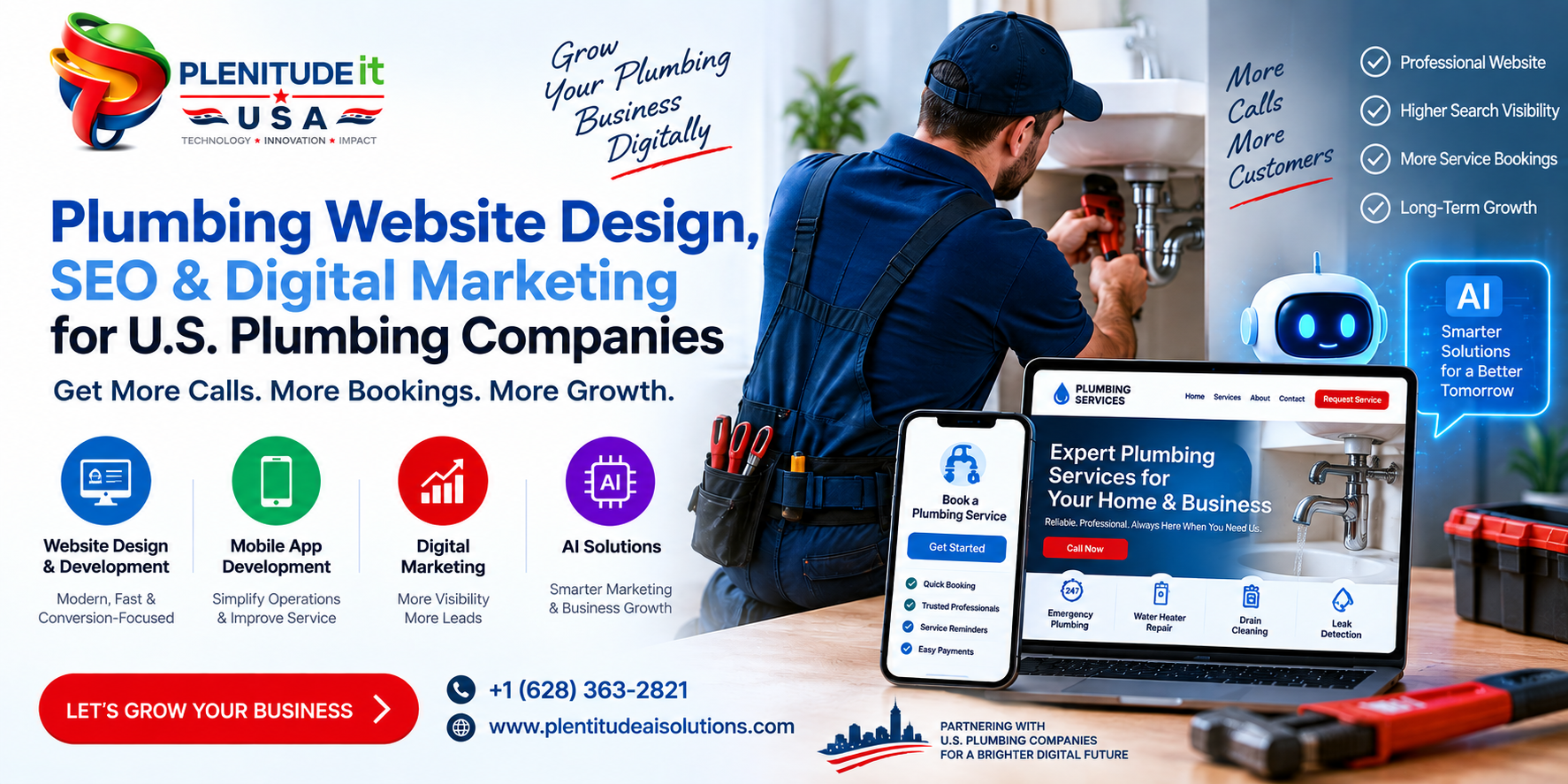
How Plenitude IT Helps Plumbing Companies Build a Stronger Digital Presence
A plumbing company shouldn’t have to treat its website, marketing, software and AI initiatives as completely separate projects.
Plenitude IT helps businesses connect those pieces into practical digital solutions.
Website Design & Development
We build responsive, conversion-focused websites designed around the services, locations and customer journeys that matter to the business.
For plumbing companies, that can mean creating clearer service architecture, mobile-first experiences, emergency conversion paths, booking functionality and technically sound foundations.
Digital Marketing
Our digital marketing capabilities include SEO, Local SEO, search marketing, content marketing, social media marketing, email marketing and online reputation management.
The goal isn’t simply more website traffic. It is to build visibility around searches that can contribute to qualified enquiries and business growth.
Mobile App Development
For plumbing companies with field technicians or more complex operations, custom mobile applications can connect technicians, customers and office teams through purpose-built workflows.
AI Solutions & AI Search Optimization
AI can support both customer-facing experiences and internal business operations.
Plenitude IT can help businesses explore practical AI applications, automation, AI-powered experiences and AI search optimization, while keeping the underlying website and content foundations strong.
The objective is simple:
Build technology that solves a business problem — not technology for its own sake.
Final Thoughts
The future of plumbing marketing isn’t about choosing between website design, SEO, digital advertising or AI.
The strongest plumbing companies will increasingly connect them.
A customer might discover a company through Google, Maps, an AI search experience, a recommendation, an advertisement or a review.
They may then visit the website on a phone, call immediately, submit a request, book an appointment and later receive a maintenance reminder.
Behind that experience is not one marketing tactic.
It is a digital system.
For U.S. plumbing companies, the opportunity in 2026 is to build that system deliberately — with a website that converts, SEO that reflects real customer intent, digital marketing that supports growth, technology that improves operations, and online information that is clear enough for both people and modern search experiences to understand.
That is where digital transformation becomes more than a buzzword.
It becomes a way to win the next customer and serve that customer better.
Frequently Asked Questions
Very important. A plumbing website needs to communicate services, service areas, trust information and contact options quickly, particularly for mobile visitors and emergency searches.
The strongest strategy combines emergency, service-specific, local and problem-based searches. Examples include emergency plumber near me, water heater repair, drain cleaning, sewer line repair, plumber in [city], and 24 hour plumber. Keyword priorities should ultimately be based on the company’s actual services and market.
No. Google’s current guidance says the foundational SEO practices that help pages appear in Search also apply to AI features such as AI Overviews and AI Mode.
AI can help with areas such as lead qualification, automated responses, scheduling assistance, follow-up and customer communication. It should be implemented around a real business process rather than treated as an automatic lead-generation solution.
No. A custom mobile app becomes more compelling when a plumbing company has multiple technicians, complex scheduling, recurring service, customer portals or operational workflows that would benefit from dedicated software.
SEO is a long-term process, and results vary significantly by market, competition, website condition and authority. A company should evaluate progress through visibility, qualified enquiries, calls and revenue rather than expecting a fixed ranking timeline.